The Real Cost of Market Impact: What TWAP and Limit Orders Actually Save You
TL;DR
- Market impact is the price you move against yourself by trading a big chunk into limited liquidity. On a typical AMM pool, the bigger your trade is relative to the pool, the worse it gets.
- TWAP orders tackle it directly: they slice one big trade into smaller parts spread over time, so each part moves the price less and the market has time to settle between them.
- Limit orders do a different job: they set the worst price you'll accept. They don't shrink your impact on their own, but they stop you paying more than you chose.
- Neither is free. TWAP trades speed and price certainty for lower impact. Limit orders trade certainty of a fill for control over price.
- TWAP is now live for every EOA wallet on CoW Swap, so you no longer need a Safe to use it.
Price impact: the tax you charge yourself
Imagine buying every sandwich at a small lunch counter. The first one costs the menu price. By the twentieth, the owner is rationing and the price has crept up. Nobody is cheating you. You just took a lot of what was on offer.
That's price impact. On an automated market maker, tokens are priced by a formula over the pool's reserves, so larger trades relative to pool depth move the price more, while smaller trades execute closer to the current spot price. The size of the move depends on your trade relative to the liquidity, not on its dollar value alone.
Three terms often get tangled, so here's the quick separation:
- Price impact is how far your own trade pushes the price.
- Slippage is the gap between the price you expected and the price you actually got. Price impact is part of it, but so is the market moving while your order waits. The slippage tolerance you set is a cap on that gap.
- MEV is value extracted by someone else who can see and exploit your trade, such as a sandwich attack. It's a separate problem. CoW Protocol's batch auction design tackles it structurally. You can read how in How CoW Protocol Actually Works.
TWAP and limit orders are about the first two. Let's put a number on the first.
A worked example
Take a deliberately simple, idealised pool: a constant-product AMM with $5M of liquidity on the side you're selling into, no fees, no gas. You want to sell $500k, which is 10% of that side of the pool.
In one go, the maths says you receive about 9.1% less than the starting spot price implied. That's roughly $45,500 of impact. Now split the same $500k into equal parts, and assume the pool settles back to the market price between parts (which is what arbitrageurs are there to do, given time):
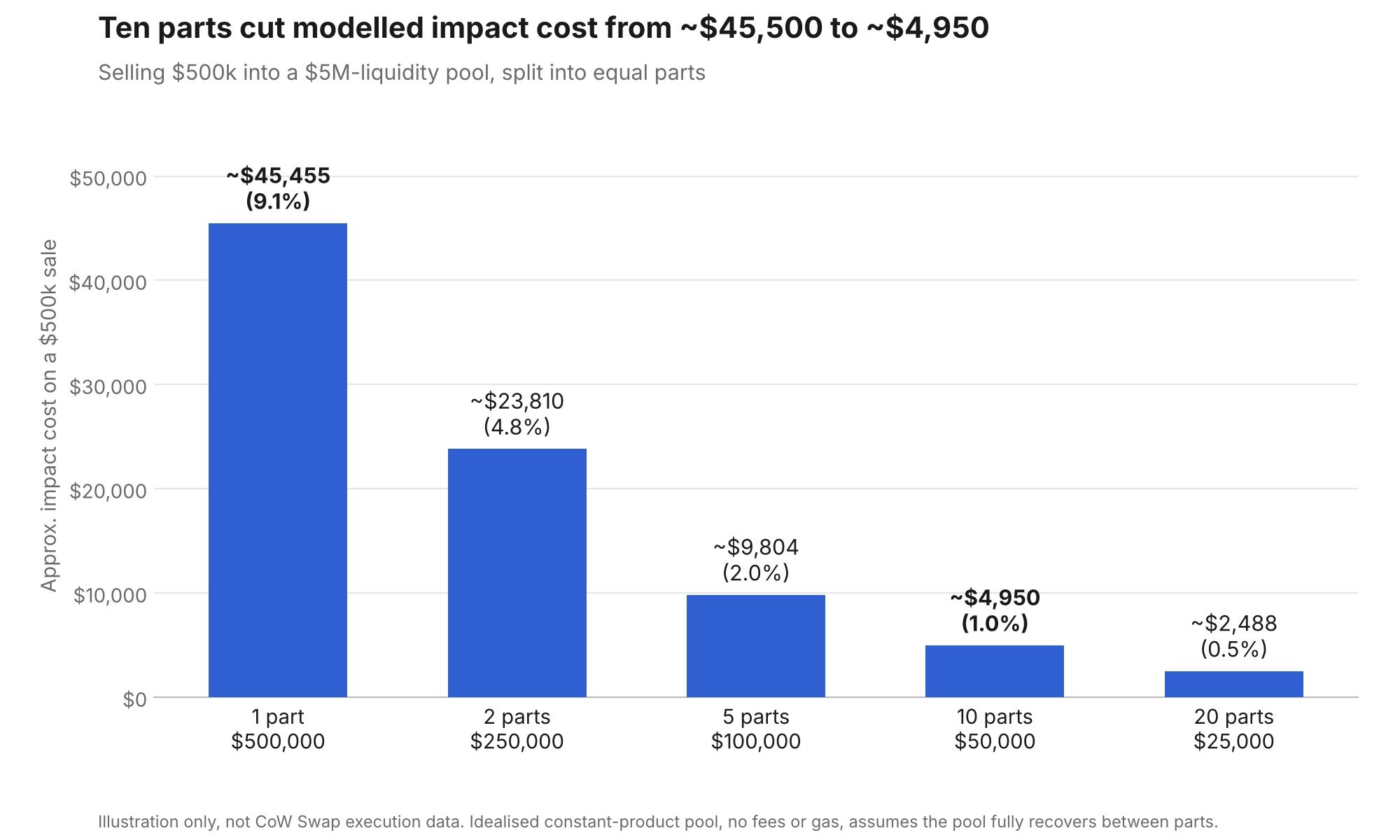
The pattern is the point: the cost of impact grows faster than your trade size, so each doubling of the number of parts roughly halves the total cost. That's why slicing works.
A few honest caveats. This is an illustration with textbook maths, not CoW Swap data. Real pools have fees and concentrated liquidity, and on CoW Swap solvers can route across multiple liquidity sources and match opposing orders directly, so your real-world numbers will differ. And the table assumes the pool fully recovers between parts, which depends on how long you wait and how active the market is. For a quick sense of the underlying curve maths, seeRaydium's constant-product explainer.
What a TWAP order actually does
A TWAP (time-weighted average price) order splits a large order into a series of normal limit orders that trade at fixed intervals. You choose the total amount, the number of parts and the total duration, which can run from hours to months. CoW Swap does the scheduling.
The CoW docs give a clean example: buying $1M of ETH over 3 hours in 6 parts means an order of about $166k every 30 minutes, which spreads the liquidity you need over time and lets the market recover between parts.
There are three reasons people reach for one, and only the first is about impact:
- Break up a trade so no single part leans too hard on the pool. This is the one our table above is about.
- Get an average price over time, rather than relying on whatever the market is doing at a single moment.
- Automate recurring buys, like a fixed amount every week or month, without coming back to place each order by hand.
One thing worth saying plainly: impact is relative to liquidity, so it isn't only a whale problem. A modest trade in a shallow pool can move the price noticeably, and a large trade in a deep one may barely register. Whether TWAP helps you depends on the token, the pool and your trade, not on a particular dollar threshold.
Price protection: the seatbelt
Spreading a trade over time exposes you to the market moving while you wait, so TWAP orders on CoW Swap include a price protection setting. It's the minimum market price you're willing to accept. If the price falls below your threshold, that part waits until the price recovers above it.
Surplus still applies
Each part is a regular CoW Protocol order, so the usual rules apply. All order surplus is forwarded to the user, meaning if a solver finds a better price than quoted, for example through a Coincidence of Wants, that improvement is yours. Curious how that works? Read What is price improvement and why is it unique to CoW Swap?
Now open to every wallet
Until recently, TWAP on CoW Swap needed a Safe. Since September 30, 2026, you can place, edit and cancel TWAP orders from any EOA wallet, live on all supported EVM chains. Funds stay in your own wallet while the order runs, and each fill respects your price protection. The full story is in CoW Swap Brings TWAP Orders to Every EVM Wallet.
New to TWAP? Start with Getting to Grips with TWAP Orders or Why TWAP?. Managing a treasury? There's apractical guide for DAOs too.
Where limit orders fit in
Here's the plot twist: a limit order isn't really an impact tool. It's a price tool.
A limit order is an order to buy or sell at a specified price before an expiration date. If the market reaches your target in that window, it executes. If not, it expires. That makes it a good fit for trades that are price-sensitive but not time-sensitive.
What that gets you on CoW Swap:
- Gasless order management. You can create, modify and cancel limit orders without paying gas.
- No fee for placing one. Instead, the protocol covers fees by executing your order at a better price than your limit. The flip side: your order may not fill the instant the market touches your limit, because the market price also has to cover network fees.
- The upside is yours. If the market is better than your limit when the order executes, you receive the better price, not just the number you typed.
- Gradual fills by default. CoW Swap sets limit orders as partially fillable, so they can fill as liquidity comes available. The docs note a small leftover can remain if it's too small to be worth the network fee of settling it.
Which order for which job?
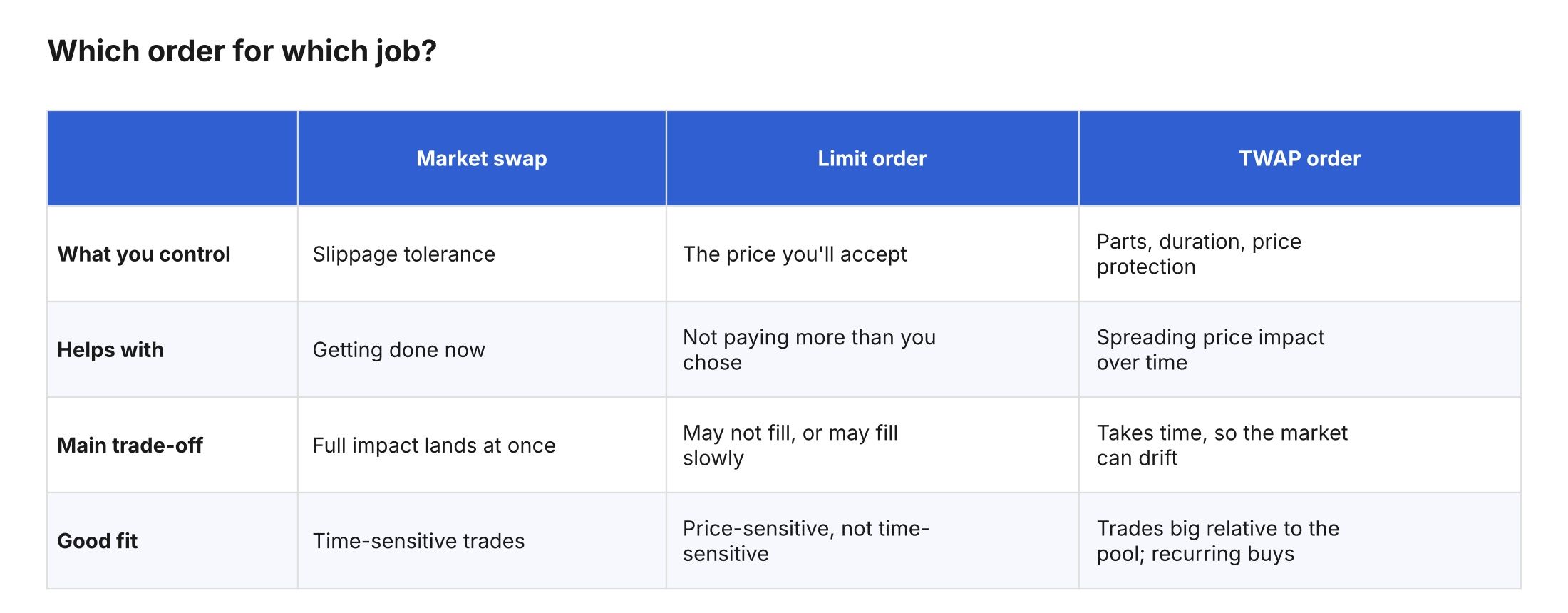
So what does a limit order save you? It caps how much you can overpay (or underreceive) on price. It doesn't make the pool any deeper, so a big order that fills right at your limit can still lean on the pool. For a trade where size relative to liquidity is the issue, that's TWAP's job. Plenty of traders use both: see Combining TWAP and Limit Orders and TWAP vs. Limit Orders: Which Should You Use and When?.
New to limit orders? How to Use Limit Orders on CoW Swap walks through it, and Why Your CoW Swap Limit Order Hasn't Filled Yet covers the most common head-scratcher.
The fine print: what you give up
Saving on impact is real, but it's a trade, not a freebie.
- Timing risk. Slicing a trade over hours or days means you're exposed to the market in between. As CoW's own VWAP explainer on time-sliced execution puts it, if the market trends sharply during the window, you can end up worse off than if you'd traded straight away. A buy spread across a rising market can average out higher than a single purchase at the start.
- More parts, more executions. Each part is settled on-chain, which carries a cost. That's why TWAP parts have a minimum size. More parts means smoother execution, but not infinitely so.
- Price protection can pause your order. It's there to keep you from trading at a bad price, so if the market stays below your threshold, parts wait. That's the seatbelt doing its job, but it also means a TWAP won't always finish on schedule.
- Limit orders might not fill. If the market never reaches your price, or the remaining amount is too small to justify the network fee, you may be left with part of the order unfilled.
The common thread: none of these tools removes risk. They let you choose which risk you'd rather hold. Impact risk, timing risk and fill risk are different bills, and you pick which one to pay.
Give it a go
On CoW Swap, open the TWAP tab, pick your tokens, then set your price protection, number of parts and total duration. The interface shows the part duration and the amount per part so you can sanity-check before you sign. Thestep-by-step TWAP guide in the docs covers each field. For limits, head to the Limit tab and set your price and expiry. Either way, check the details carefully before you sign.
FAQ
What's the difference between price impact and slippage? Price impact is how far your own trade moves the price. Slippage is the broader gap between the price you expected and the price you got, which includes price impact plus any market movement while your order waits.
Do limit orders reduce market impact? Not by themselves. A limit order sets the price you'll accept, so it caps how much you can overpay or underreceive. It doesn't deepen the pool. If your trade is large relative to liquidity, slicing it with a TWAP is the more direct tool.
Does a TWAP guarantee a better price than a single swap? No. It spreads the impact over time, which often helps, but you're exposed to the market moving while the order runs. Price protection limits how far it can drift against you, though it can also cause parts to wait.
How many parts should I use? There's no universal number. It depends on how deep the pool is, how long you can wait, and how volatile the token is. More parts and a longer duration smooth things out but extend your exposure to the market. The interface shows the amount per part, and each part has to meet a minimum size because it settles on-chain.
Do I need a Safe wallet for TWAP orders? Not any more. Since September 30, 2026, any EOA wallet can place, edit and cancel TWAP orders on CoW Swap.
Can I use TWAP for recurring buys? Yes. Because parts run at regular intervals, a TWAP can automate a fixed purchase every week or month, as set out in the launch announcement.
Does it cost anything to place a limit order? There's no fee for placing one. CoW Protocol covers the fees by executing your order at a better price than your limit, which is why an order can sit unfilled for a moment after the market touches your price.
Is this the same as MEV protection? No, they're separate things. Price impact is a cost of your own trade size. MEV is value extracted by others who can see and exploit your transaction. On CoW Swap, orders are signed intents settled by solvers in batch auctions, rather than public swap transactions, which is the structural basis of its MEV protection. Slicing your order helps with impact. The architecture addresses MEV.
Can I cancel a limit order? Yes. Off-chain cancellation is free, but it isn't instant, so an order can settle before the cancellation goes through. An on-chain cancellation costs gas and has the same race.