How Small Can You TWAP? Order Minimums and Costs on Every Chain
TL;DR
-
TWAP orders split one trade into smaller parts. Each part settles on-chain, so each part has a minimum sizethat keeps execution costs from eating your savings.
-
For now, the minimum per part is $1,000 on Ethereum Mainnet and $1 on every other chain CoW Swap supports for TWAP. (Sepolia, the test network, is $10.)
-
You don't need to memorise any of this. The CoW Swap TWAP form shows the minimum, your fees and what you'll receive before you place the order.
-
On cost, the protocol volume fee is 2 bps on standard pairs and 0.3 bps on stable/correlated pairs. That's $2.00 and $0.30 on a $10,000 trade.
-
TWAP is now open to any EVM wallet, not just Safes. Big or small, same order type.
First, why does a TWAP have a minimum at all?
Picture a pizza. Slicing it into 8 pieces is great. Slicing it into 800 pieces means you're mostly paying for the knife.
A TWAP order works the same way. You pick how many parts to split your trade into and how long the whole thing should run, and CoW Swap places each part at regular intervals. Smaller parts mean less price impact per part. But every part still has to settle on-chain, and settlement isn't free.
So CoW Swap sets a floor per part. If a part is too small, the cost of settling it could outweigh the price impact you saved by splitting. As the docs put it, each part "will need to be executed on-chain, meaning there's a cost associated with each execution."
The floor changes from chain to chain, because the cost of settling on-chain does too.
The minimums, chain by chain
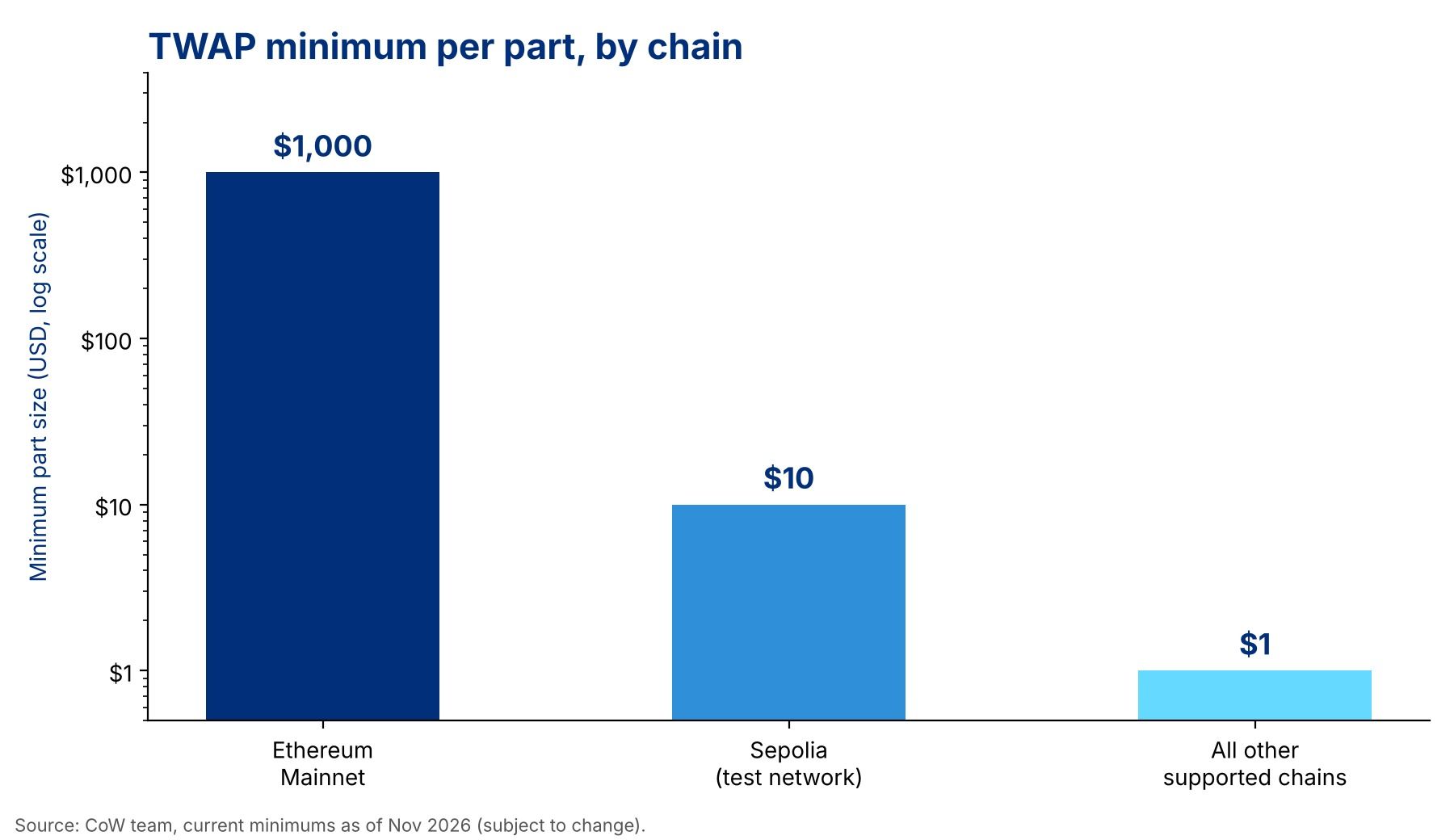
Heads up: these are today's numbers. Minimums can change, and you may spot older figures elsewhere. Earlier posts like the original TWAP launch announcement quote $5,000 on Mainnet and $5 on Gnosis Chain, and parts of the docs still do too. The TWAP form always shows the minimum that applies to your order, so trust that.
What this means in practice
Minimums cap how many parts you can use. The maths is simple: max parts = total trade size ÷ minimum per part.
-
$10,000 on Mainnet (at $1,000 per part): up to 10 parts.
-
$100 on any other chain (at $1 per part): up to 100 parts.
Small trade on Mainnet? You may not have room to slice at all. That's the nudge toward the other chains.
And the costs?
Two kinds of cost matter here: what the protocol charges, and what it costs to settle each part on-chain.
1. Protocol fees
CoW Protocol's fee page lists the models currently active. The one that applies to every order is a volume fee:
-
Standard assets: 2 basis points (0.02%)
-
Correlated assets (stables/RWAs): 0.3 basis points (0.003%)
There's also a quote improvement fee on market orders (50% of positive quote improvement, capped at 0.98% of volume) and a surplus fee on out-of-market limit orders and discrete TWAP parts that aren't executable when generated. The chart above shows only the volume fee. Your actual fee depends on how each part executes.
2. Settlement cost per part
Each part settles on-chain, so more parts means more total settlement cost. This is the real reason chain choice matters: the same TWAP costs different amounts to settle on different networks. Orders on CoW Swap are gasless to place, with fees paid in the sell token, but the minimums exist because network costs are baked into each part.
We don't publish a per-chain gas table, because costs move with network conditions. What we can say: every chain other than Mainnet has a far lower minimum, and that gap tells you how the cost of settling a part compares.
Let the UI do the sums
Here's the good news: you don't have to work any of this out by hand. The CoW Swap TWAP form shows the numbers for your exact order, live, before you sign anything:
-
Minimum sell size. If your parts are too small, a notice tells you the minimum per part on that chain (for example, "at least $1") and suggests two fixes: fewer parts, or a bigger total.
-
Receive (incl. fees). The amount you'll receive after fees, so the cost isn't a surprise.
-
Quoted price. The current price for your pair.
-
Worst acceptable price. Your price protection, set as a percentage. A part won't execute if the price moves beyond it.
-
Sell and buy per part. What each slice will sell and buy, with approximate dollar values.
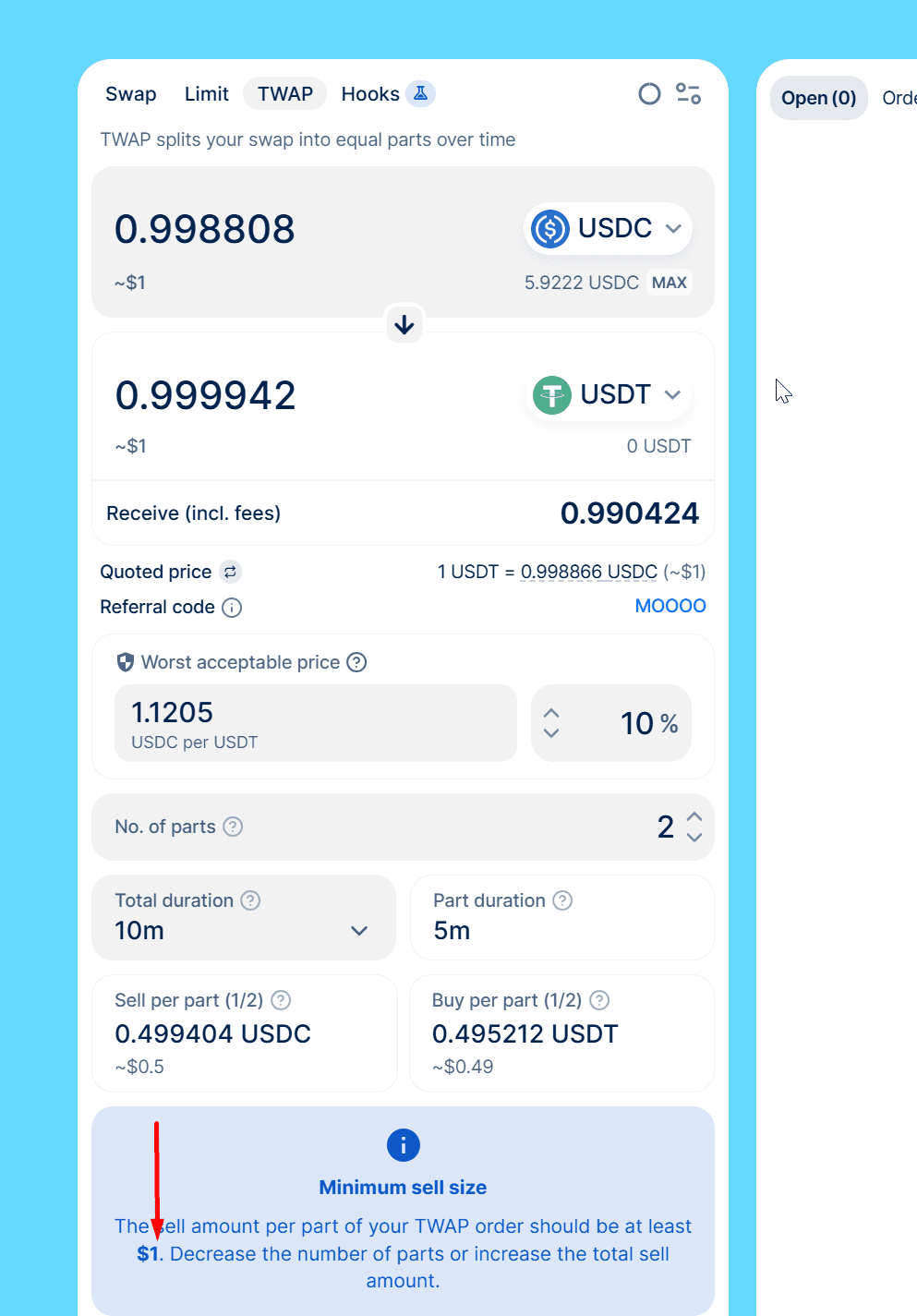
Play with the number of parts and the total duration, and watch those figures update. It's the fastest way to find the sweet spot between fine slicing and fee drag.
Choosing a chain: a quick rule of thumb
Large trade, deepest liquidity? Mainnet works. Your parts clear the $1,000 floor easily.
Smaller trade, or you want lots of parts? Any chain besides Mainnet gives you room to split finely at $1 per part.
DCA-style scheduled buys? A low per-part minimum means regular small buys are practical.
Don't have a Safe? You don't need one
TWAP used to be Safe-only. That barrier is gone: any EVM wallet can now place, edit and cancel TWAP orders directly in the CoW Swap UI. Funds stay in your own wallet while the order runs, and every part respects the price protection you set.
Want the longer story on how TWAP works? Start with Understanding TWAP or what you need to know about crypto TWAP orders.
FAQ
What is the minimum TWAP order size on CoW Swap?
For now, $1,000 per part on Ethereum Mainnet and $1 per part on every other supported chain. The TWAP form also shows the minimum for your order, so you can confirm it when you trade.
Why are the minimums different on each chain?
Each part of a TWAP settles on-chain, and settlement costs differ between networks. The minimum keeps those costs from outweighing the price impact you save by splitting.
Is the minimum for the whole order or for each part?
Per part. Total size ÷ minimum per part gives you the maximum number of parts.
Do I need a Safe wallet?
No. Any EVM wallet can now place TWAP orders on CoW Swap.
What does it cost to place or cancel a TWAP?
Orders on CoW Swap are gasless to place, with fees paid in the sell token. Protocol fees apply as described on the fees page.
What's the protocol fee on a TWAP?
The volume fee is 2 bps on standard assets and 0.3 bps on correlated assets. Other fee models can apply depending on how each part executes.
What about Polygon, BNB Chain, Avalanche, Linea, Base, Arbitrum and others?
$1 per part, same as Gnosis Chain. Mainnet is the only chain with a higher minimum.
Where can I see the minimum and my costs before I trade?
In the CoW Swap TWAP form. It shows a minimum sell size notice, your receive amount including fees, the quoted price, and sell and buy per part.
What is price protection?
A setting that stops a part from executing if the price moves beyond the percentage you choose.