TWAP Orders for DAO Treasuries: A Practical Guide
TL:DR
-
A DAO that holds most of its treasury in one token has a runway problem, and selling it all in one go can move the price against you.
-
A TWAP order on CoW Protocol splits one big trade into equal parts that run at fixed intervals. Each part is a normal limit order, so it settles through CoW Protocol's batch auctions like any other trade.
-
You set the number of parts, the total duration and a price protection level. Safe signers approve the whole schedule once, instead of re-voting on every sale.
-
A TWAP spreads out price impact and averages your entry or exit over time. It does not predict the market, and it is not always the right tool.
-
Pin down the parameters in the governance proposal, agree who signs, and make sure your Safe is set up before the vote passes.
The treasury problem: a big bag and a long runway
Picture a DAO treasury as a bathtub. Most of the water is one token: the DAO's own. The tap (revenue) is slow, the plug (salaries, audits, grants) is open, and the water level swings with the token price. Diversifying into stablecoins or ETH is how you stop the level from dictating whether you can pay people next quarter.
The tricky part is the swap itself. Governance-token treasuries tend to be concentrated, and when the price falls the treasury shrinks in dollar terms while the bills stay the same. GSR's analysis describes the feedback loop: falling price, pressure to sell more tokens to cover costs, more downward pressure. DL News has reported on DAOs weighing this exact trade-off as they decide how much to sell and how fast.
A single large market swap makes your own trade the main character. It has to be filled from the liquidity that exists right now, so the price you get drifts away from the price you saw. That drift is price impact: the cost of your trade size against the depth of the market. It is not the same thing as slippage (price moving between quote and execution) or MEV (value extracted by reordering transactions). Treasury trades can run into all three, and a TWAP only addresses the first directly.
The idea behind a TWAP is old and simple: instead of one big trade, do n smaller trades, one every t minutes, hours or days. Give the market time to absorb each piece and recover before the next.
How a TWAP works on CoW Protocol
According to the CoW Protocol docs, a TWAP order splits a large order into a series of normal limit orders that trade at fixed intervals. You choose how many parts and the total duration, which can run from hours to months. Because every part is an ordinary order on CoW Protocol, it goes through the same solver competition and batch auctions as any other trade. That is where CoW Protocol's structural MEV protection lives, and it is why a TWAP is more than a cron job firing swaps.
You set four things:
-
Assets. What you are selling and what you are buying, just as in a regular swap.
-
Number of parts. How finely the order is sliced.
-
Total duration. The window the parts are spread across. Part duration is simply total duration divided by the number of parts.
-
Price protection. A floor, expressed as a percentage from the market price when the order was placed. The docs give a 10% example: if the price moves unfavourably by more than that, the order does not execute. A part held back by this floor waits rather than filling at a price you did not sign up for.
Under the hood the programmatic order reference describes a TWAP as n smaller trades every t seconds from a start time t0, with an optional span that limits how much of each interval a part stays valid. It is always a sell order, with a minimum buy amount per part. Treasuries usually think in totals, so the interface does the division for you and shows sell and buy amounts per part before you sign.
Safe wallets. The step-by-step tutorial walks through placing a TWAP from a Safe, which is how most DAO treasuries hold funds. Open CoW Swap as a Safe App, pick the TWAP tab, and sign. If your Safe does not yet have the special fallback handler that TWAP orders need, the interface prompts you to upgrade it, and the docs note that process has been extensively audited. Multi-signature setups may need several signatures before the order becomes active. Cancelling works the same way: it creates a Safe transaction that needs your signers too.
TWAP orders are no longer Safe-only, either: as of late September 2026, any EOA wallet can place, edit and cancel them directly in CoW Swap. For a DAO the Safe route will still usually be the right one, because the signing threshold is the point.
A worked example (hypothetical DAO)
Meet Moo DAO, an invented organisation. Its signers want to convert 3,000 ETH into a stablecoin to cover roughly a year of operating costs, and they would rather not do it in one afternoon. Here is how they might set it up:
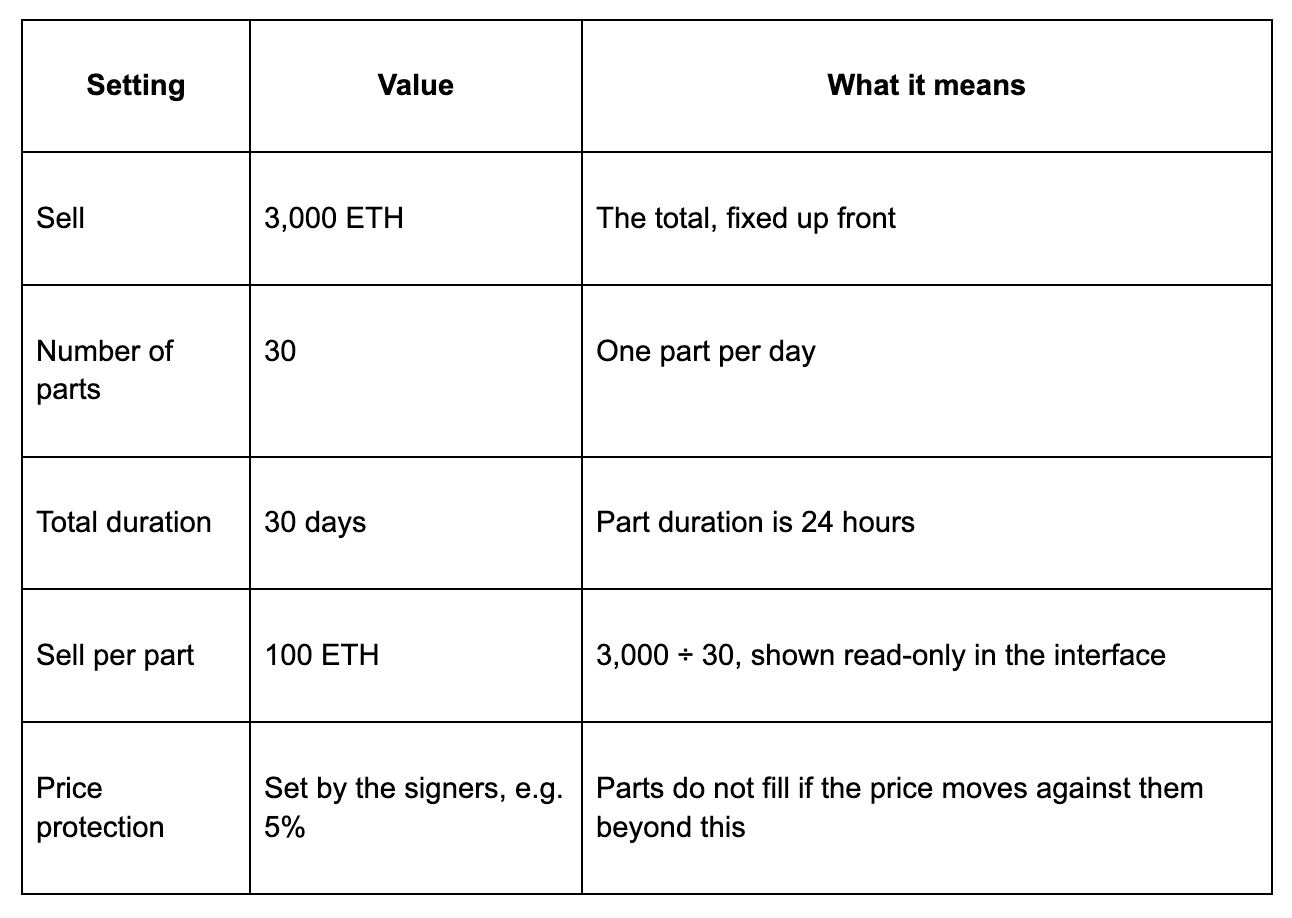
The CoW Protocol docs use the same arithmetic: an order of 12,000,000 DAI sold over 30 days becomes 30 parts of 400,000 DAI each, with the minimum buy amount divided the same way.
Two things Moo DAO should check before signing. First, each part has to clear the minimum order size, and the CoW docs currently quote different minimums on different pages, so confirm the live figure for your chain and your part size before you finalise the schedule. Second, review the approval you are asked to sign: the docs advise checking that the spender address is the TWAP contract's, and revoke.cash can show you your approvals afterwards.
Once signed, the parent TWAP shows up in the order overview and can be expanded to see each individual part, with its own receipt and execution details. You can follow fills in CoW Explorer, which gives the DAO a public record to point at in its next treasury report.
Getting it through governance
The best-known public debate on this question came from ENS. ENS DAO delegates voted to sell 10,000 ETH for USDC via CoW Swap, with 89% in favour according to The Block. The proposal as voted was a single swap, but theforum discussion is worth reading because it surfaces the honest arguments on both sides:
-
One delegate argued the DAO should split the sale into smaller amounts over several months. Others pointed out that a DCA is not guaranteed to beat a single trade, and that executing at once was a legitimate strategy given the DAO's ETH-heavy treasury.
-
A contributor noted that the price impact of a 10k ETH sell was under 1%, so a TWAP would not help much on impact alone, unless the goal was to average out exposure to price volatility.
-
Another contributor showed that a TWAP-style schedule could run on the same order infrastructure, with an example of 2 ETH split into 8 hourly parts.
-
Delegates also raised that every extra sale needing its own vote is a burden, and that there is a one-week delay between proposing and executing.
The takeaway for your own proposal: say why you are using a TWAP. Is it to reduce price impact on a thin pair, to average your exit across a volatile stretch, or to make the sale less of an event for the token's holders? Different goals point to different parameters, and delegates will ask.
Whatever the goal, write the schedule into the proposal so that signers have nothing left to improvise. Things worth pinning down:
-
The asset pair and the total amount, or a clear formula for it.
-
The number of parts and the total duration, with the resulting size per part.
-
The price protection percentage, and what the signers do if parts stall because the price sits below it.
-
Which Safe holds the funds, who the signers are, and the threshold needed to place or cancel the order.
-
The receiving address for the proceeds.
-
Who reports back, when, and where the public record lives.
If your DAO governs from a platform rather than directly from a Safe, check whether it can reach CoW Swap. Aragon's dApp Connect, for example, lets a DAO propose swap actions by connecting to CoW Swap as a dApp.
A checklist for the signers
-
Confirm the Safe has the fallback handler TWAP orders need, and upgrade it before the vote if not.
-
Check that every part will clear the minimum order size on your chain, using the live docs.
-
Agree the price protection level, and how you will react if parts stall below it.
-
Build in slack: leave room in the duration for parts that wait on price protection.
-
Verify the approval's spender address matches the TWAP contract before signing.
-
Make sure enough signers are available for both placing and cancelling, since each is a Safe transaction.
-
Note the order's link in CoW Explorer and schedule the report-back.
When a TWAP is not the answer
A TWAP is a tool, not a verdict. A few honest limits:
-
It does not time the market. You are still exposed to price moves while the schedule runs. A TWAP gives you an average over the window, which can be better or worse than a single trade on day one. The ENS thread above is a good reminder that reasonable delegates disagree on this.
-
It is slower by design. If you need the cash this week, a schedule that runs for a month does not help.
-
Small trades may not need it. If your trade is a small fraction of the available liquidity, price impact is already low and splitting adds complexity without much benefit. The docs also set minimum part sizes, so tiny trades cannot be sliced finely.
-
Other routes exist. Depending on your size, token and goals, a private OTC sale or a single swap through CoW Swap may fit better. CoW Swap can sometimes fill an order against another trader's opposing order (a Coincidence of Wants) without touching on-chain liquidity at all, which is worth knowing before you slice up a trade.
If you are unsure, run the numbers on your own pair first: compare the quoted price impact for the full trade against a single part.